 Codeaholicguy
What changes for engineering managers when engineers have agents
Contents
- The split I have always expected
- Agents change the cost of execution
- Organizations are getting flatter
- Coordination-only management is going away
- Where the freed space goes
- People development stays, and changes shape
- Direction is the gap between good and great
- Management is a different path, not a promotion
- Closing
I wrote about the new 10x engineer with AI and then about the practical habits to get there. Both posts were about engineers. This one is about the people who manage them, because the engineering manager role is shifting too.
The split I have always expected
For a long time, I have had a simple expectation of engineering managers. I apply it to myself, and I expect it from every EM who works with me.
- 10% team vision and direction
- 20% people development
- 30% hands-on work
- 40% team priorities, stakeholder management, and coordination
It is not a timesheet. It is a rough picture of where an EM's attention should go in a normal month.
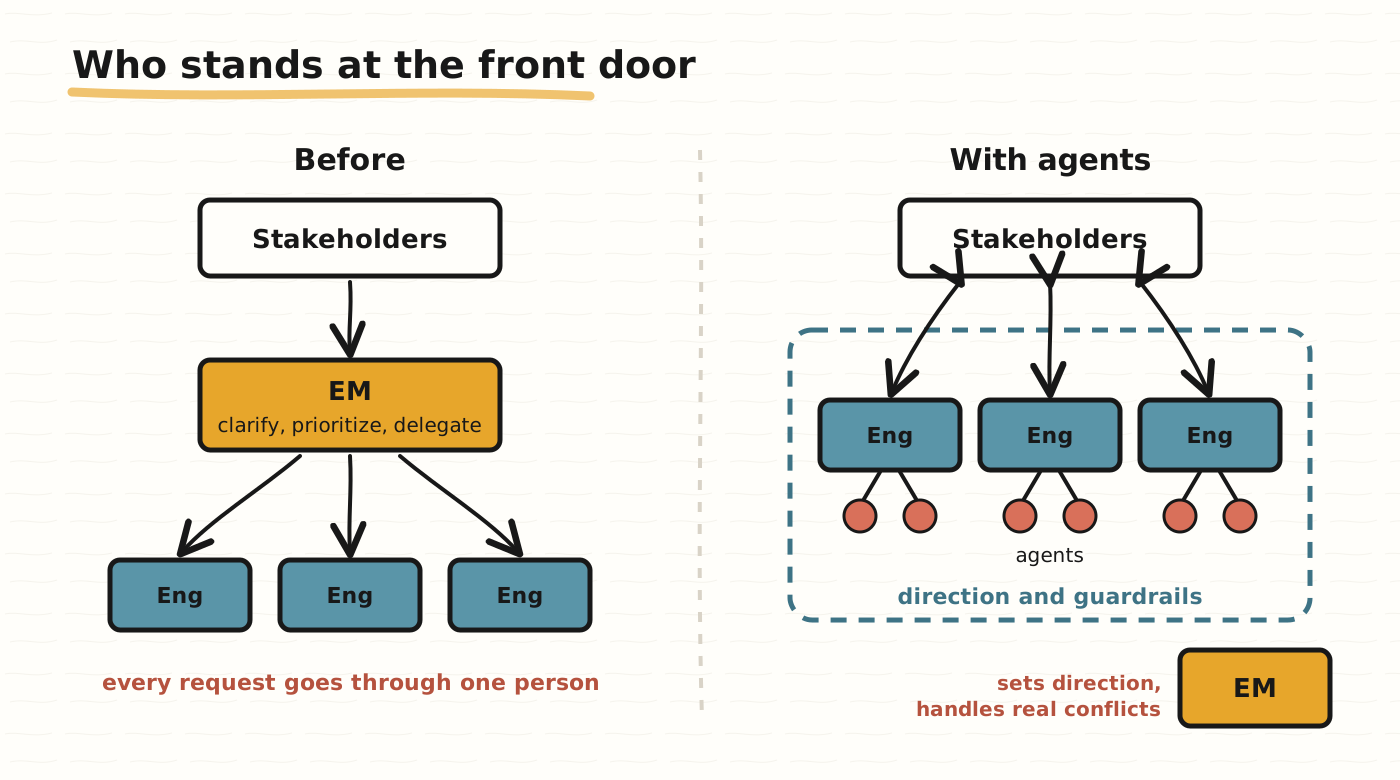
The 40% was the biggest slice for a reason. Execution was expensive. Engineers needed long, focused blocks of time with their hands on the keyboard, and every interruption had a real cost. So the EM became the front door of the team. Requests came in, the EM discussed and clarified them with stakeholders, worked out the priority, and only then delegated the work. While the work was in progress, the EM kept handling the coordination and communication so the team could stay focused.
That model made sense when building was the slow part.
Agents change the cost of execution
Today, engineers can delegate a large part of execution to coding agents. Exploring an unfamiliar codebase, writing the first version of a feature, generating tests, and updating the same pattern in ten places can all be handed off. The engineer still owns the result, but their hands are no longer stuck on the keyboard for the whole day.
That changes who can stand at the front door.
An engineer who has a few agent sessions running can also talk to the stakeholder, clarify the request, decide on the approach, and keep people updated. A lot of the work that sat in the EM's 40% is the same work a modern 10x engineer already does: turning an unclear problem into a safe, shippable outcome with little coordination overhead.
This is not only my observation. LeadDev's Engineering Leadership Report 2026 found that 37% of engineering leaders are doing more hands-on technical work than in 2025, and among engineering managers the share rose from 20% to 35% in one year. Company expectations are moving in the same direction. Shopify's CEO asked teams to demonstrate why they cannot get what they want done using AI before asking for more headcount.
There is a limit. Human attention does not scale the way agents do, and I hit that wall myself when I tried to run many agents in parallel. Not every engineer can absorb every request. But the direction is clear enough: the part of the EM role that existed to protect engineers from incoming work is getting smaller.
Organizations are getting flatter
At the same time, large companies are removing management layers.
Amazon asked each of its senior leadership teams to increase the ratio of individual contributors to managers by at least 15% by the end of Q1 2025. Google said it had 35% fewer managers with small teams than a year earlier. Microsoft's May 2025 layoffs were aimed at reducing management layers. Meta did something similar back in its 2023 "year of efficiency".
I want to be careful here. Much of this started for cost and bureaucracy reasons, and some of it before coding agents were useful. Amazon's memo explained the extra layers as a side effect of fast growth, not AI. What AI changes is that wider teams become more workable. When engineers need less routing and shielding, one manager can support more of them. The numbers already show teams getting bigger. Gallup found that the average number of people reporting to a manager went from 10.9 in 2024 to 12.1 in 2025, almost 50% higher than when they first measured in 2013.
Coordination-only management is going away
I will say this out loud. If most of your value as a manager comes from routing requests, running status meetings, and passing messages between stakeholders and engineers, that role is going away.
It reminds me of telephone switchboard operators. For a long time, a person had to connect every call by hand. Once people could dial directly, that job faded. The calls did not stop. The need for someone in the middle of every call did.
How much coordination remains depends on the organization. Some places have heavy cross-team dependencies, regulated processes, or stakeholders with conflicting goals, and someone still needs the authority to make the call. But even there, the work changes shape. Instead of personally routing every request, the EM's job becomes making priorities clear enough that engineers can triage most requests on their own and escalate only the real conflicts.
That is a very different job from being the front door.
Where the freed space goes
When the 40% shrinks, the space does not stay empty. In my view, the organization will expect an EM to use it in one of three ways:
- Do more hands-on work with the same team.
- Own more domains or more teams.
- Manage a much bigger team, possibly two or three times the size of the past.
Here is my rough guess of what the split looks like in each case. These numbers are not a standard. They are a way to make the shift concrete.
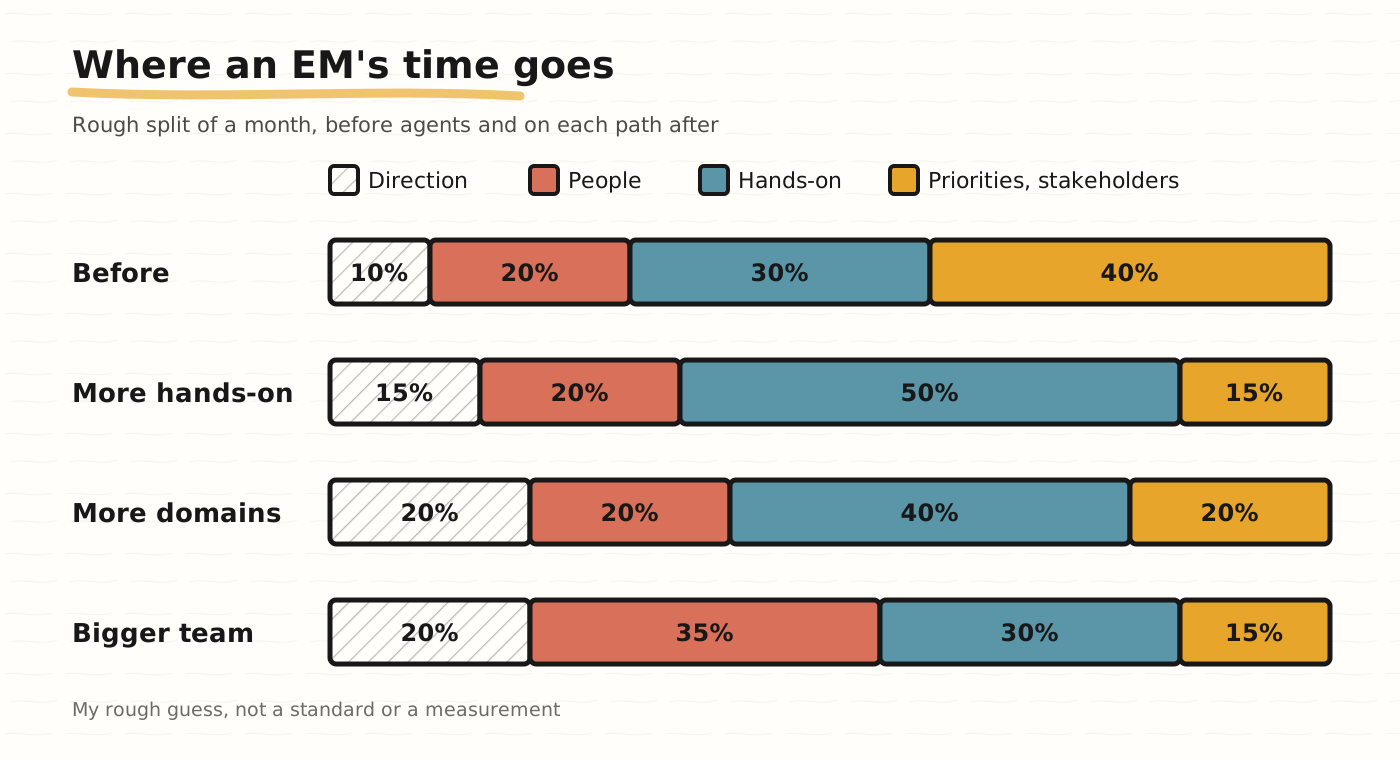
A few things stand out to me. Hands-on work never drops below 30%, whichever path you take. Direction goes up in every path. And the priorities slice never goes to zero. It just stops being the biggest part of the job.
The trap is trying to do all three at once. Gallup's research on span of control found that managers who spend more than 40% of their time on individual contributor work have lower engagement, and it gets worse as their team grows. They also warn that widening spans without reducing the manager's own workload weakens day-to-day performance management. LeadDev's report found that 45% of leaders are working more hours than a year ago, and one in three managers are considering going back to IC. That is what happens when the org adds scope without taking anything away.
So my advice is to choose the path deliberately and agree on it with your manager. If you go more hands-on, pick leverage work: prototypes, unblocking hard problems, reviewing agent plans, and building tools that make the whole team faster. At 50% hands-on, keep the team size roughly where it is, because heavy IC work on top of a growing team is exactly the combination Gallup found hardest. Avoid owning critical-path tickets, because the moment a people issue needs you, that ticket stalls. And as your team grows, keep your hands-on time, but move more of it toward work that helps the whole team rather than tickets of your own.
People development stays, and changes shape
Google's Project Oxygen famously set out to show that managers do not matter and found the opposite. Gallup says managers account for 70% of the variance in team engagement. None of that changes because engineers have agents.
What changes is the math. If you spend 20% of your time developing people and your team triples, each person gets much less of you unless you change how you do it. These are the things I would focus on.
Turn 1:1s from status updates into growth conversations. I have recommended this long before AI, but it matters more now. Status can come from tools, dashboards, and agents. The 1:1 is for career, feedback, and the things people will not say in a group. Adjust the cadence by need: weekly for someone in a transition, biweekly or monthly for someone who is stable.
Scout opportunities and keep a backlog of them. People grow by taking on work slightly beyond their current level. With agents, projects finish faster, so stretch opportunities get used up faster too. A good EM is always looking for the next problem that can grow someone: a cross-team project, an ownership gap, a system nobody understands well, a new domain. Keep a list, and match those opportunities to people deliberately instead of waiting for them to show up.
Grow leads who coach. With a bigger team, you cannot be the only source of feedback and guidance. Senior engineers and tech leads who mentor others multiply your impact without adding another management layer.
Coach through real work. Review how people frame problems, the context they give their agents, and the decisions they make on trade-offs. When agents write a lot of the code, judgment is the thing you are developing, so judgment is what you should review.
Pay special attention to early-career engineers. Agents can make it easy to ship something that works without understanding why. Make sure juniors still build fundamentals, and that they can explain the work they ship. When you evaluate performance, look at the outcomes and the decisions, not the amount of code.
Developing people now also includes developing how they work with AI. That is hard to do credibly if you never use the tools yourself. Share the workflows that work for you, ask engineers to show you theirs, and treat it as something the team learns together.
Direction is the gap between good and great
Of the four parts, team vision and direction is the one people forget most. It is never urgent. There is always a stakeholder waiting, an incident to follow up, or a hiring loop to close. So the 10% quietly becomes zero.
In my experience, this is the difference between a good EM and a great one, in the past and in the future. A good EM keeps the team delivering. A great EM knows where the team is heading, explains it clearly, and influences people to move in that direction together. When that happens, the team does not need to be pushed. It pulls in the same direction on its own.
It matters even more now, because direction is what replaces the routing. When engineers take requests directly, they need a way to decide what matters. Without a clear direction, each engineer prioritizes for whoever is loudest, and the team drifts. With a clear direction, most decisions can be made without you.
Think about the difference between turn-by-turn instructions and a destination with a map. If you are driving everyone yourself, turn-by-turn works. Once people drive on their own, they need to know where they are going and what the terrain looks like.
Good direction also needs a perspective on the problem space, not only the system or product you own. If your team owns search, the question goes beyond how the search service should evolve. It includes how the way people look for things is changing, what users and the business will need in two or three years, and what that means for your team. Owning a system tells you what to fix next. Understanding the problem space tells you where to go.
A few habits help:
- Write the direction down. A short document that says where the team is going, why, and what you will not do is more useful than a long strategy deck.
- Repeat it. People need to hear the direction many times, in planning, in reviews, and in 1:1s, before it sticks.
- Connect decisions to it. When you say yes or no to a request, explain how it relates to the direction. That is how engineers learn to make the same call without you.
- Revisit it as the problem space changes. Direction is a perspective, not a fixed plan.
I wrote before that if engineers do not know where we are going or why, they will not be invested. With agents, they also will not be effective, because they will point a lot of execution capacity at the wrong things.
Management is a different path, not a promotion
There is a misconception I want to correct here, because it matters more now. Moving from IC to manager is not a promotion. It is a change of career path.
Many tech companies design two parallel tracks for this reason. GitLab's handbook, for example, describes Staff-level roles and Engineering Manager roles as equivalent in base compensation and prestige, and says managers should self-select into that track instead of feeling pushed. An IC can keep growing to staff and principal levels without managing anyone. A manager is not above them. They do a different job.
Whichever path you take, staying close to technical work is more important than before. When agents write a large part of the code, the scarce skill is judging whether the output is right: whether the design fits the system, whether the trade-off holds up, whether the change is safe to ship. A manager who has drifted far from the technology cannot make those calls, cannot coach engineers on them, and cannot lead AI adoption with any credibility. A small team with agents can also change a system much faster than before, so a wrong technical direction gets expensive quickly. The managers I expect to do well are the ones who still read code, use the tools themselves, and understand their systems well enough to ask the right questions.
So if you are choosing between the two paths, be careful. As organizations get flatter, they need fewer people in the middle layer. Management roles will be fewer, wider, and more demanding. Choosing management because it looks like the next step up is a risky bet. The IC path does not cap your growth, and in this era it may give you more leverage.
For me, the reason to move into management was never the title. I love growing people. Being a tech lead taught me a lot about mentoring and coaching, and helping someone grow became the part of the work I enjoyed most. Then I wanted to do it at a bigger scale. The management track gave me the tools and the system for that: hiring, shaping teams, creating opportunities, and building the structures that help people grow even when I am not in the room. My ideal has been to build a team in Vietnam where engineers own the full product lifecycle, grow into strong engineers and leaders, and are ready to work at the best companies in the world.
If that is not what pulls you toward management, the IC path is a great path to stay on.
Closing
The engineering manager role is not disappearing. The version that mainly routes requests and coordinates execution is.
If you are an EM, a useful exercise is to look at your last month and compare it with the old 10/20/30/40 split. Mark the time that went into work engineers with agents could now handle. Then pick the path you want to grow into, write down where your team is heading, and start building the leads and the opportunity backlog that will let you develop more people.
The parts that make an EM great have not changed. Develop people, and know where your team is going. What has changed is that there are fewer places to hide when you skip them.
If this perspective resonates with you, subscribe to my blog. I share what I learn while building real systems and teams with AI in the loop. You can also follow me on X or Threads for more thoughts and ongoing experiments.